What the NCC's 7-star NatHERS requirement measures, where Tasmania's adoption stands, and why a modelled rating is the floor rather than the ceiling for performance.
Under the National Construction Code 2022, new homes in most of Australia must achieve a 7-star NatHERS energy rating. Tasmania deferred that requirement — and at the time of writing in mid-2026 it still hasn’t taken effect here, so Tasmania’s minimum remains lower. Here’s what the stars measure, what they don’t, and what that means for your build.
What is a NatHERS star rating?
NatHERS — the Nationwide House Energy Rating Scheme — rates the thermal shell of a home’s design on a scale of 0 to 10 stars. Accredited software models how much energy the design should need for heating and cooling, based on the insulation, glazing, orientation, layout and construction, in the climate where it will be built. More stars means the design should need less energy to keep comfortable.
Two words in that paragraph deserve your attention: design and should. We’ll come back to them.
Does the 7-star requirement apply in Tasmania?
Here’s the situation as honestly as we can put it — and the part you must verify for your own project.
NCC 2022 lifted the national minimum for new homes from 6 to 7 stars, and most states and territories have adopted it. Tasmania chose not to adopt the 7-star energy provisions. The state has repeatedly deferred the newer energy-efficiency requirements, and as of mid-2026 Tasmania’s minimum energy-efficiency standard for new homes remains at the earlier, lower requirements — with the state’s adoption timetable for newer NCC editions having shifted more than once and still in motion.
Because that timetable has moved before and may move again, don’t build a decision on this article — or any article. Confirm the requirements that apply to your project with your building surveyor or energy assessor at the time you design. They’ll know exactly which edition and which provisions your approval will be assessed against.
But here’s the more useful point: the regulatory floor in Tasmania is, for now, lower than the rest of the country’s. Whatever you think of that as policy, as a homeowner it means one thing — the minimum standard will not deliver you a high-performing home in the coldest capital-city climate in Australia. If you want performance, you have to choose it.
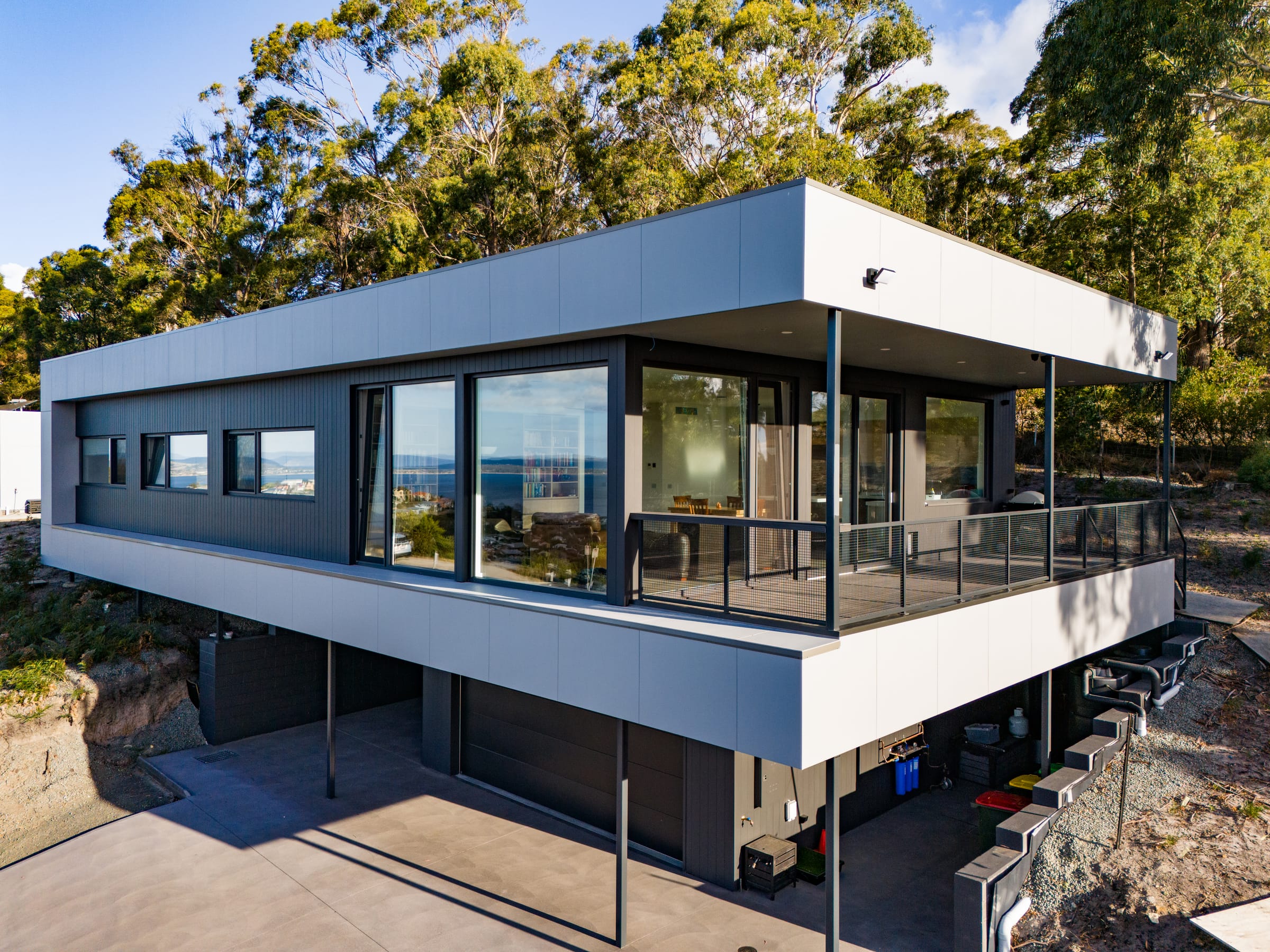
Bluebush, Blackmans Bay — our certified Passive House, and 2026 HIA Australian GreenSmart Home of the Year.
What does a 7-star home actually get you?
Compared with the 6-star homes Australia built for a decade, a genuine 7-star design is a meaningful step: better insulation, better glazing, more attention to orientation. Modelled heating and cooling loads drop noticeably. As a floor — a minimum below which no new home may fall — 7 stars is good policy for a cold climate.
The mistake is treating the floor as a target. Star ratings are minimums that the design must clear, not descriptions of excellence. A 7-star home in Hobart or Launceston will still need substantial heating through a Tasmanian winter. It’s a better version of a conventional home — it is not a different kind of home.
What doesn’t a star rating measure?
This is the part of the system most buyers never hear about, and it comes back to those two words — design and should.
A NatHERS rating is a model of the drawings, not a measurement of the house. The stars are awarded at design stage. Whether the finished building actually performs as modelled depends entirely on execution: insulation installed continuously rather than stuffed in with gaps, junctions detailed properly, the envelope actually sealed. And the single biggest gap in the scheme is airtightness — there is no mandatory as-built airtightness test for Australian homes. A home can carry its stars proudly while leaking heat through every unsealed junction, and no one will ever measure it.
That execution gap is a big part of why so many Tasmanian homes — including recent ones — end up cold, damp and streaming with condensation. We’ve unpacked the building science in why Tasmanian homes get cold and damp; the short version is that a rating on paper doesn’t warm a room. Built performance does.
Bluebush, Blackmans Bay — tested at 0.5 air changes per hour against a limit of 0.6.
What’s beyond 7 stars?
Verified performance — and in our view, that’s the standard a Tasmanian Forever Home should be judged against.
A certified Passive House inverts the star-rating logic. Instead of modelling the design and hoping the build follows, certification requires the finished home to prove itself: airtightness measured on site with a blower-door test, heating demand and total energy verified against hard limits by an independent certifier. Miss a number, and there’s no certificate. It’s the difference between a home that was designed to perform and a home that was shown to.
The results speak plainly. A certified Passive House needs roughly 80–90% less heating energy than a typical build. Our own certified home at Blackmans Bay, Bluebush, tested at 0.5 air changes per hour and a verified heating demand of 10 kWh/m² a year — numbers measured on the completed building, not predicted from its drawings. To see what that level of performance would do to your own bills, run them through our Passive House savings calculator.
And you don’t have to certify to build well. Every energy-efficient home we deliver applies the same building science — continuous insulation, real airtightness detailing, performance glazing, controlled ventilation — because that’s what actually keeps a Tasmanian home warm and dry, whatever number is printed on the certificate.
The bottom line
Treat 7 stars — whenever and however it lands in Tasmania — as what it is: the floor. A well-executed 7-star home is a decent conventional house. A verified high-performance home is a different experience of winter entirely. If you’re building the home you plan to keep, ask a better question than “does it comply?” Ask “can you prove how it performs?” — and talk to our Passive House team about what the answer can look like.
Thinking about building?
Talk to our team — or get a 48-hour feasibility on your plans.