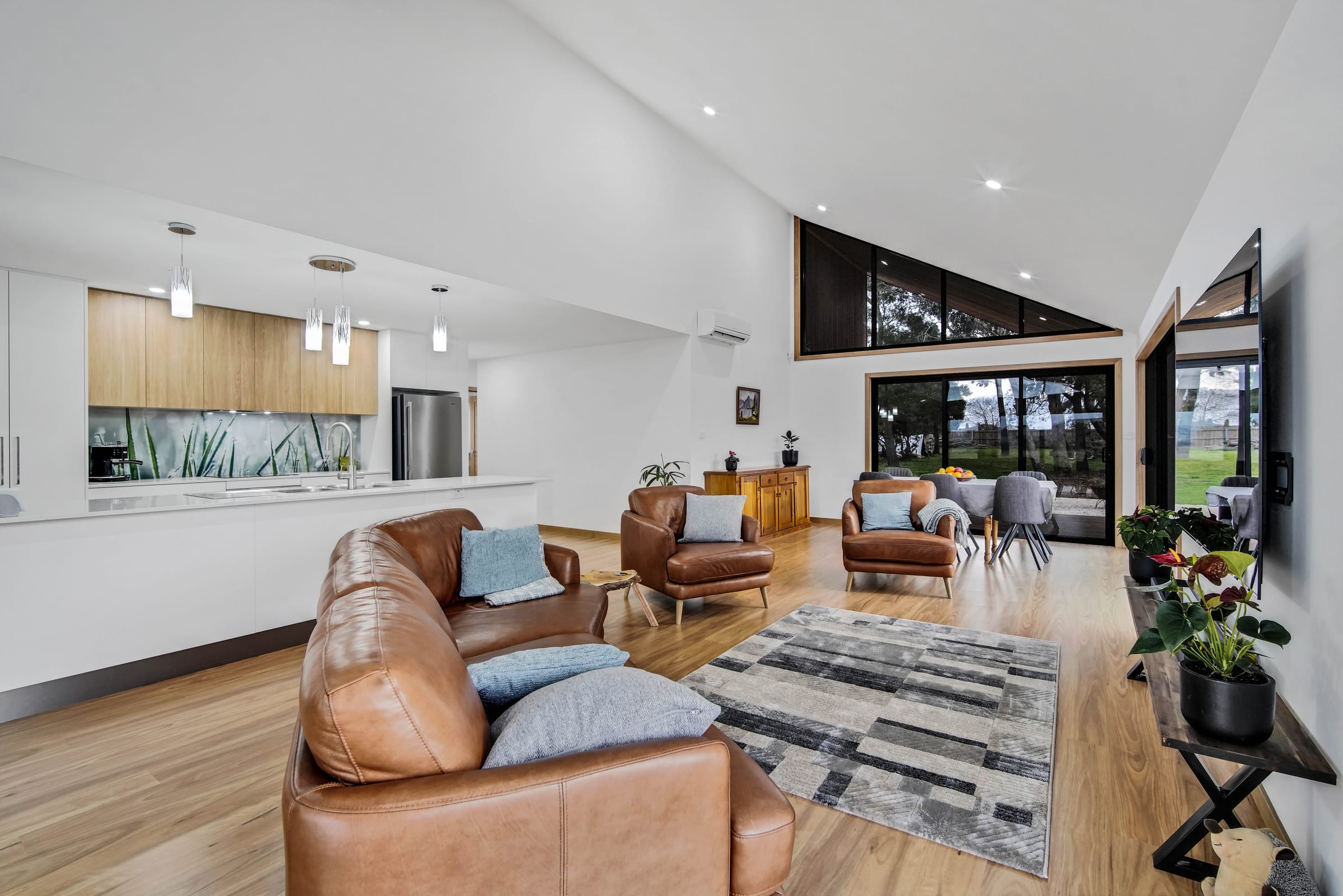
Love the location, not the house? An honest look at knock-down rebuild versus renovating versus moving in Tasmania, and how to get a real number before you commit.
A knock-down rebuild means demolishing your existing house and building a brand-new home on the same block. In Tasmania it’s often the right call when you love the location but the house is beyond sensible renovation — you keep the land, the street and the view, and replace the building that’s failing you.
Here’s how to work out whether it’s the right call for your block.
What is a knock-down rebuild?
Exactly what it sounds like: the existing dwelling comes down, and a new custom home goes up in its place. You already own the land — usually the hardest and most expensive part of any build to get right — so the project becomes a new build on a known site rather than a hunt for one.
It sits between two alternatives, and the honest comparison is against both: renovating what’s there, or selling and moving to something better.
Knock-down rebuild vs renovation: which one wins?
It depends on what’s actually wrong with the house.
Renovation wins when the bones are good: sound structure, workable layout, and problems that are cosmetic or contained. A kitchen from 1994 is a renovation. A bathroom that’s tired, a floor plan that needs one wall moved — renovation territory, and our home renovations team does exactly this work.
A knock-down rebuild starts winning when the problems are in the bones themselves. Failing footings or structure. A layout so wrong that fixing it means rebuilding half the house anyway. And — the big one in Tasmania — a building envelope that can never be made to perform. Retrofitting continuous insulation and airtightness into an existing home is possible, but it’s expensive, disruptive and rarely gets you to new-build performance. If the reason you’re renovating is that the house is permanently cold, damp and mouldy, read why Tasmanian homes get that way first — because that problem is solved far more completely, and often more economically, by starting again.
The trap with major renovations is that the real scope hides inside the walls. What’s priced as a big renovation can grow, discovery by discovery, until you’ve paid new-home money for a compromised result. When the renovation quote approaches rebuild cost, the rebuild almost always wins — you get a new structure, a new envelope, new services and a warranty, instead of new surfaces on old problems.
Verndene, Sandy Bay — the existing home kept its street frontage; everything behind it changed.
Knock-down rebuild vs moving house
Moving looks simpler until you price the whole move. Selling costs, agent fees, stamp duty on the new place, removalists — and at the end of it, you’re often buying someone else’s compromises in a location you liked less than the one you left.
A knock-down rebuild flips that. The location — the school zone, the street, the outlook, the neighbours — is usually the thing people are least willing to give up and the thing money finds hardest to buy back. If your block is genuinely well located, keeping it and replacing the house is often the strongest financial and lifestyle position. You end up with a brand-new home, built for how you actually live, on land you’d struggle to buy today.
Moving wins when the block itself is the problem — wrong size, wrong orientation, wrong area — because no rebuild fixes a bad block.
What does a knock-down rebuild cost in Tasmania?
Two components: demolition, then the new build.
Demolition varies too much for an honest headline figure — it depends on the size and construction of the existing house, site access, and whether hazardous materials such as asbestos are present, which is common in older Tasmanian homes and adds to removal cost. It’s quoted per site, and we won’t pretend otherwise.
The new build is a custom home like any other: ours typically start around $5,000 per square metre in 2026. The full breakdown — and what moves that number up or down — is in our guide to the cost to build in Tasmania.
One genuine advantage: a knock-down site is a known site. Services are already connected, the ground has held a house for decades, and access is established. Compared with a greenfield block, there are usually fewer unknowns to price in.
Verndene, Sandy Bay — a covered outdoor room added off the rear extension.
What’s the knock-down rebuild process?
Feasibility first — before you commit to anything. This is the step that protects you. Our 48-hour feasibility gives you a number within 10% of true build cost before you’ve spent anything on design, so you can compare rebuild against renovation or moving with real figures instead of guesses.
From there, the process runs like any custom build, with a demolition stage at the front: design, planning and building approvals (including demolition approval through your council), disconnection of services, demolition and site clearing, then construction of the new home. Approvals and requirements vary by council and site — your building surveyor confirms exactly what applies to your block.
Everything we price along the way is open-book: two quotes from every trade, every line visible, and a 10% net margin we publish. On a project where you’re weighing three different futures for your biggest asset, you deserve numbers you can actually interrogate.
How do you know which way to go?
Run the honest test. Get a renovation scope priced properly. Get a rebuild feasibility done. Price the full cost of moving, stamp duty included. Then compare what each dollar actually buys: patched performance, new performance, or someone else’s house.
Our experience across custom homes in Tasmania is that people regret half-measures far more often than they regret rebuilding. If the house is fundamentally wrong and the block is fundamentally right, a knock-down rebuild is how you keep everything you love and fix everything you don’t — once, properly, for the decades ahead.
Thinking about building?
Talk to our team — or get a 48-hour feasibility on your plans.