What a Certified Passive House Costs in Tasmania (2026)
The honest numbers: what certification adds to a Tasmanian build, where the money goes, and what you get back, with verified figures from our own certified home.
In 2026, our custom homes in Tasmania typically start around $5,000 per square metre, and certification to the Passive House standard adds roughly 15% — so budget from about $5,750 per square metre. In return you get independently verified performance: roughly 80–90% less heating energy than a typical build, for the life of the home.
That’s the short answer. The longer answer is worth reading, because the premium is real — and so is what it buys.
Why does a certified Passive House cost more?
Because it has to prove itself. A conventional home is signed off on paperwork; a certified Passive House is signed off on measured results. Before a certificate is issued, an independent certifier checks the home against hard limits — heating demand, airtightness under a blower-door test, total primary energy — and if any number misses, there is no certificate. We’ve laid out exactly what those limits are in what certified Passive House actually means.
Hitting those numbers takes more than good intentions. It takes design-stage energy modelling, a continuous insulated envelope with no thermal bridges, airtightness detailing at every junction, high-performance glazing, and mechanical ventilation with heat recovery. Each of those costs more than the standard alternative. None of them is optional.
So yes — the premium exists, and any builder telling you certification is free is telling you something else too.
Where does the extra 15% actually go?
Most of it lands in four places:
The envelope. More insulation, installed continuously, with junctions detailed and taped so the blower-door test passes. This is labour and care as much as material.
The glazing. High-performance double or triple-glazed windows and doors — usually the single largest line in the premium. They’re also the reason the inside face of the glass stays warm and dry all winter.
The ventilation system. Mechanical ventilation with heat recovery (MVHR) supplies constant filtered fresh air and reclaims most of the heat from the outgoing stale air. A conventional home simply doesn’t have this system, so it’s a genuine addition.
Certification itself. Energy modelling, independent certification and on-site testing. It’s the smallest slice — and it’s the part that turns claims into evidence.
What you’re not paying for is a different-looking house. Passive House is a performance standard, not a style. The architecture is whatever you and your designer want it to be.
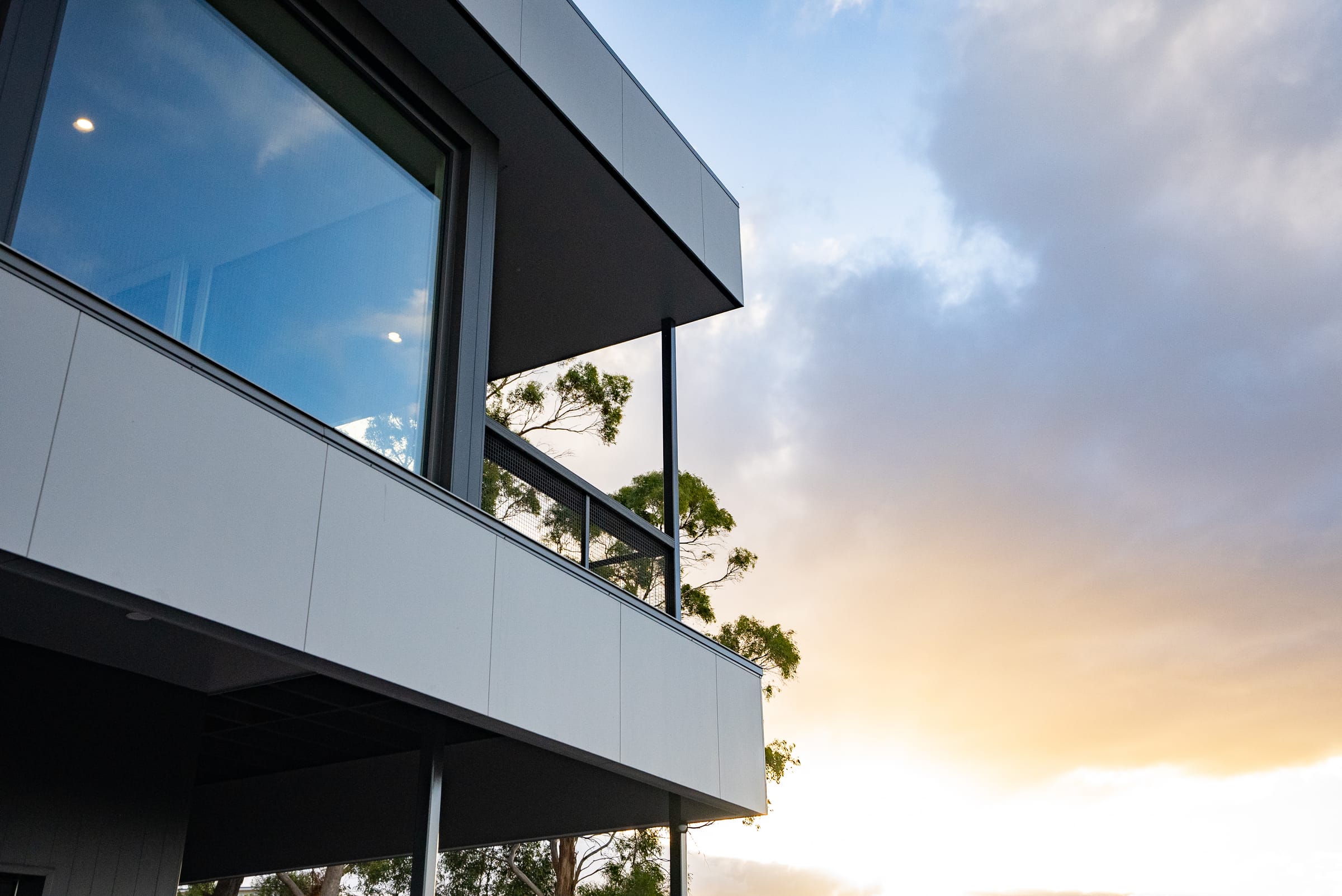
Bluebush, Blackmans Bay — a heating demand of 10 kWh/m² a year, against a limit of 15.
What do you get back?
Lower running costs, every year, forever — and a home that’s warm, dry and mould-free without fighting for it.
A certified Passive House needs roughly 80–90% less heating energy than a typical build. In a climate where heating is the dominant energy cost — we’ve broken down what actually drives Tasmanian heating bills — that’s not a rounding error. It’s the difference between a winter power bill you brace for and one you barely notice.
The payback isn’t only financial. The same envelope that slashes the heating bill also eliminates the condensation and mould that plague conventional Tasmanian homes, because interior surfaces never get cold enough for moisture to land on. If that’s part of why you’re building, start with why Tasmanian homes get cold and damp.
To put your own numbers on it, run your current power bills through our Passive House savings calculator. It’s the honest way to weigh the premium: not “is it more expensive to build” — it is — but “what does the home cost to own over ten, twenty, fifty years.”
What has a real certified Passive House in Tasmania actually achieved?
We don’t have to speak hypothetically. Bluebush, our certified Passive House Classic at Blackmans Bay, was independently certified with tested results of:
Airtightness: 0.5 air changes per hour — against a limit of 0.6
Heating demand: 10 kWh/m² a year — against a limit of 15
Primary energy (PER): 48 kWh/m²·yr — against a limit of 60
Those aren’t design intentions. They’re measured, verified numbers from a completed Tasmanian home — one of only a handful of certified Passive House homes in the state. That’s what the premium buys: not a promise of performance, but proof of it.
Bluebush, Blackmans Bay — our certified Passive House, and 2026 HIA Australian GreenSmart Home of the Year.
Is a certified Passive House worth it in Tasmania?
Here’s our honest take. If your budget is stretched to its absolute limit just getting a home built, full certification may not be the right call — the same building-science principles can be applied without certifying, and every energy-efficient home we build benefits from them.
But if you’re building your Forever Home — the one you intend to live in for decades — Tasmania is arguably the best place in Australia to certify. Our cool-temperate climate is where the standard delivers its biggest wins, and the heating energy you don’t buy compounds every single winter. The premium is paid once. The performance is permanent.
And there’s a subtler value: certainty. In a market full of “built to Passive House principles” claims that nobody ever checks, certification is the one version of high performance that arrives with independent evidence attached. You’re not trusting the builder’s word. You’re reading the certifier’s numbers.
How do I get a real number for my project?
Square-metre rates are a starting point, not a price. Your site, your design and your specification all move the number — which is why we put every project through a 48-hour feasibility that lands within 10% of true build cost, certified Passive House included.
From there, everything is open-book: two quotes from every trade, every line yours to inspect, and a published net margin of 10%. If you’re going to pay a premium for verified performance, you deserve to see exactly where every dollar of it goes.
For the broader picture — including what conventional custom homes cost across the state — read our full guide to the cost to build in Tasmania. And when you’re ready to talk about your own site, our Passive House team — the largest certified Passive House team in Tasmania — is the right place to start.
Thinking about building?
Talk to our team — or get a 48-hour feasibility on your plans.